Two Standards
In the beginning, there was Descriptive notation. Descriptive notation was the standard for many years, and is still almost universally understood when used. Algebraic notation is the current standard and has been the official FIDE notation starting in 1981. In the last decade or so, it has been almost exclusivly used in chess books, even to the extent of classic titles being republished using Algebraic notation.
Descriptive notation does have a natural advantage in verbal instruction because it is "descriptive". Consider saying, "pawn to King 4" or "rook takes pawn", as opposed to "e4" or "rook takes d6." It makes sense to a child or novice, is easy to visulaize, and is much easier to teach to children. Consider teaching (or learning) algebraic notation using an unlabled board (hmm, which collum is 'g' again?..).
Algebraic notation is the current standard and is clearly superior to descriptive notations in many ways. Primarily, it is a much cleaner written format and is also less ambiguous. Algebraic is much easier to read then the more laborous descriptive notation, and is also much easier to record quickly and accurately while playing.
In either format "O-O" is castling kingside, "O-O-O" is queenside, "ep" is en passant, "!" is good, and "?" is bad. Check and Mate are "ch" and "mate" in descriptive, or "+" and "++" in algebraic.
Descriptive Notation
In Descriptive notation, everything is counted from the back row to the far row for both sides, i.e. white's row 1 is black's row 8. The files are named after the piece which occupies it, and whether it is king side or queen side. The format of the notation is name the piece and tell where it goes.
If the pawn in front of the king is moved forward two spaces, it is described, "P-K4". If the pawn in front of the queenside knight is moved forward one space, it is "P-QN3". If a knight at K5 captures a rook on Q7, it would be "NxR" or if clarification is needed, "NxR(Q7)" or "N(K5)xR".
Algebraic Notation
In Algebraic notation, everything is counted from the white's queen's rook's square, which is the lower left corner of the board. The rows are numbered one through eight, and the files are lettered 'A' through 'H'. The format of the notation is name the piece and tell where it goes. If a pawn is moved, only the destination is named.
If the pawn in front of the king is moved forward two spaces, it is described, "e4". If the pawn in front of the queenside knight is moved forward one space, it is "b3". If a knight at e5 captures a rook on d7, it would be "Nxd7" or if clarification is needed, "N(e5)xd7".
Notations Compared
Sicilian Defense
Classical Dragon, MCO col. 80, pg 276
Algebraic
White | Black |
| 1. e4 | c5 |
2. N-f3 | d6 |
3. d4 | cxd4 |
4. Nxd4 | N-f6 |
5. N-c3 | g6 |
6. B-e2 | B-g7 |
7. O-O | O-O |
8. B-e3 | N-c6 |
|
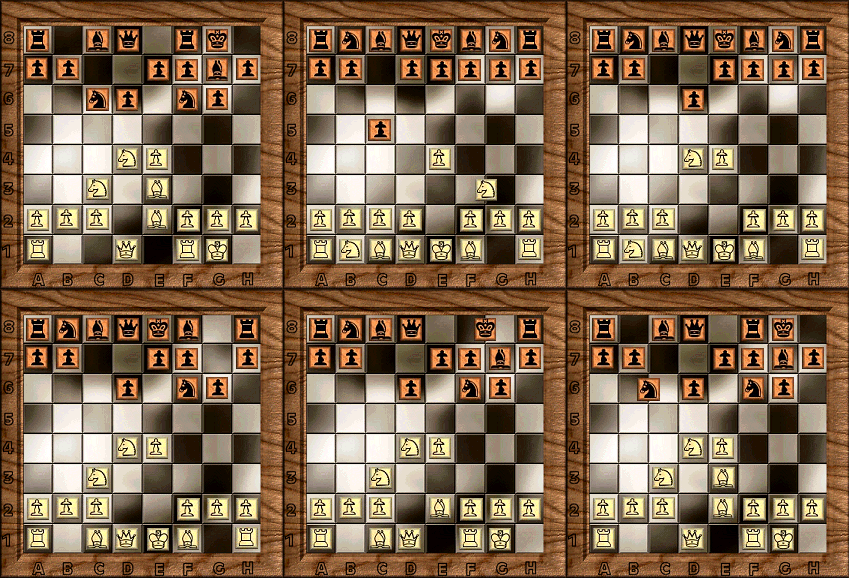
|
Descriptive
White | Black |
| 1. P-K4 | P-QB4 |
2. N-KB3 | P-Q3 |
3. P-Q4 | PxP |
4. NxP | N-KB3 |
5. N-QB3 | P-KN3 |
6. B-K2 | B-KN2 |
7. O-O | O-O |
8. B-K3 | N-QB3 |
|
|
