Why study positional play before studying tactics?
"Tactics flow from a superior position" - Bobby Fischer
The difference between positional and tactical play is NOT one of Offence or Defense, but it is the difference between controlling the battlefield and executing attacks. Positional play should be thought of as taking the high ground, clearing roads, obstructing enemy routes, while tactical play is the actual execution of coordinated attacks. In fact, positional objectives are often the purpose behind tactical manuevers - ever exchange a bishop for a knight in order to expose the enemy king?
It is impossible to effectivly study tactics without first having at least a rudimentary understanding of positional concepts. It is also unlikly that most positional concepts will be realized without instruction. Therefore, any one who wants to improve from their "natural" level of play should begin with a study of positional play.
Positional play has two main goals; controling space and controling movement.
Controling space means occupying or denying access to the center, and to the majority of the squares. It also includes keeping a defensive structure intact. Controling movement means opening lanes for your pieces and denying movement to your opponent's pieces. This also applies to breaking up the opposing king's defenses.
Key Elements in Positional Play
- Begin studying book openings. All book openings are positionaly sound. They are immediatly instructional and advantageous. I do not recommend playing the openings past about 10 moves, or memorizing more than 4 openings until you're pretty comfortable with using them. Also, select openings that mirror the way you already play or that seems natural and makes sense to you. For me, that was the Scotch Game or the Ruy Lopez.
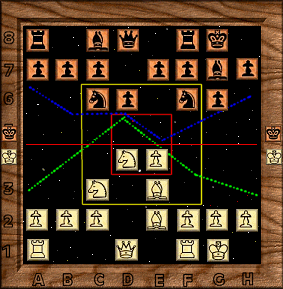
- Control the center 4 squares. These 4 squares, and also the surrounding 12 squares, are your main target for spacial control of the board. Consider: If your structure has a peak in the middle you can dodge in and out from behind it, while your opponent is divided and must slide around in his back two rows. Note: Some strategies focus on kingside or queenside spacial control, but the center is always important!
- Develop your pieces. OK, keep a rook bodyguard, but rooks & bishops need open lanes, preferably line your bishops up on your opponent's king. Knights should be posted across the centerline when they're not integral to your structure. Your queen should be developed last, she's primarily a defensive piece for the first several moves and does real well at E2 (or E7).
- Control your pawns. Those feisty pawns! Try not to double them or isolate them. Don't expose your king after you've castled, (in the midgame you will want to move one of the castled king's pawns forward one). Try not to tie up pieces defending pawns, pawns can do that!
- Attack the board, not the chess men. Attack in such a way that the resulting reaction causes doubled or isolated pawns, clutters lanes, or exposes the king. Decline exchanges which are not positionally favorable. Think - Alterior Motive.
- Create [passed pawns]. This is a pawn with no opposing pawn in front of it or on the two adjacent files. This is important endgame setup. If you can effectively protect and advance a passed pawn it will rock your opponent's world.
Once these concepts become natural to you, and you've developed a sense of control over the board space and movement, then you'll have the foundation needed for tactical applications!
|