What are Tactics?
Tactics are strategic methods of employing your chess men and should result both from careful planning and from dynamic opportunities. The Tactical Concepts discussed here are both fundamental and effective!
I have grouped these concepts into four areas:
- Tactical Attacks
- Tactical Exchanges
- Initiative
- Pattern Recognition
- Tactical Attacks
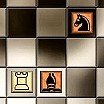
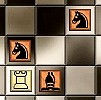
- Forks - A fork is when a piece moves to a position where it threatens 2 or more pieces at the same time, like a rook advancing against a bishop and a knight (Image 1). Which ever piece moves, the rook takes the other. Forks can often be defended by either moving one targeted piece to a position where it can protect the other (Image 2a), or by advancing some other piece which can protect both targets (Image 2b).

1. Rook forks
Bishop and Knight.
| 
2a. Knight escapes
and protects Bishop.
| 
2b. A second Knight
advances and protects both.
|
- Pins - Pins are a tactical capability of Bishops, Rooks, and Queens. A pin is similar to a fork, in that two pieces are attacked, but the first is targeted with a secondary target becoming available if the first piece is moved away. This has the effect of immobilizing the "pinned" piece (the Bishop in the example below).
Pins are "removed" by moving the second target (the Queen in our example), or, if the secondary target cannont be moved and the pinned piece is needed, a substitue can be moved inline to protect the second target, freeing the first piece. this forms the Skewer illustrated below the pin.
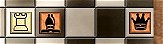
The pinned Bishop protects the Queen.
- Skewers - A skewer is similar to a pin, but three or more pieces are targeted in a line.
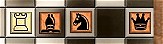
Skewered like a shish-kabob,
but the Bishop can now leave.
- Discovered attacks - A Discovered attack happens when the attacking piece is lined up on the target, but is blocked by a screening piece, for example a black rook lined up on the white king with a black bishop between them on the same file or row, preventing the attack. When the interposing piece is moved, it creates a discovered attack.
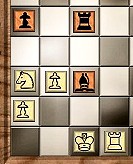
Any Bishop move will cause a
"Discovered" check on white's King.
- Tactical Exchanges
- Exchange against sole protectors - This is when multiple exchange opportunities are available and an exchange is enacted against a supporting piece, allowing a material advantage on the following turn.
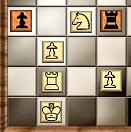 |
In this example black pawn takes pawn with white taking back with his Rook for an even exchange, but the exchange leaves the knight unprotected, and black takes it next. |
- Exchange for positional objectives - This is when material is exchanged in order to establish a positional advantage such as doubling opponent pawns or exposing the enemy king.
- Exchange by counter attack - Counter attack is the response to an attack which cannot be effectivly defended, by attacking at an unrelated point. For example, one player cannot defend his Rook, but he can attack his opponent's Rook, Queen, or King - causing his attacker to choose between his own attack or a response to your counter attack.
- Initiative - If your opponent's first priority is responding to you, you have the initiative. It's the dynamic element of being the Agressor instead of the Defender and is not necessarily a factor of positional or material advantage! Getting the initiative is the trick - consider the points below:
- Attacking - Attacking is a sure way to seize the initiative, just make sure the attack makes sense!
- Advancing a Pawn - "I'll trade you a rook for my pawn...?" If a pawn's likly to promote its value increases as it travels! If you have multiple pawns in the endgame advancing them is just like attacking.
- Crossing the Line - Any time your pieces are on the far side of the board they are a source of pressure. Knights and passed pawns are special considerations!
- Lined on the King - Another source of pressure is when a bishop, rook, or queen is placed in a direct line to the opposing king (or his immediate surroundings), especially if the lane is open up to a pawn or so...
- Pattern Recognition
- Openings - Familiarize yourself with standard openings and use them. These will bring you to recognizable midgames every time!
- Known Tricks & Traps - Usually in the Opening, often risky and unsound positionally. These should primarily be learned so as to be avoided or countered.
- Midgame Mates - The book, "How to Beat your Dad in Chess" is excellent for this. This book is a manual of pattern recoginition based check mates.
- Endgame Techniques - The most obvious place for pattern recognition, and for the sharpening of tactics in general.
How to Study Tactics
Work with the concepts and suggestions above, as well as the following:
- Study Positional concepts.
- Record and Analyze your own games.
- Read analysis's of tournament games by Masters.
- Work through published Chess Exercises/Problems.
|

